
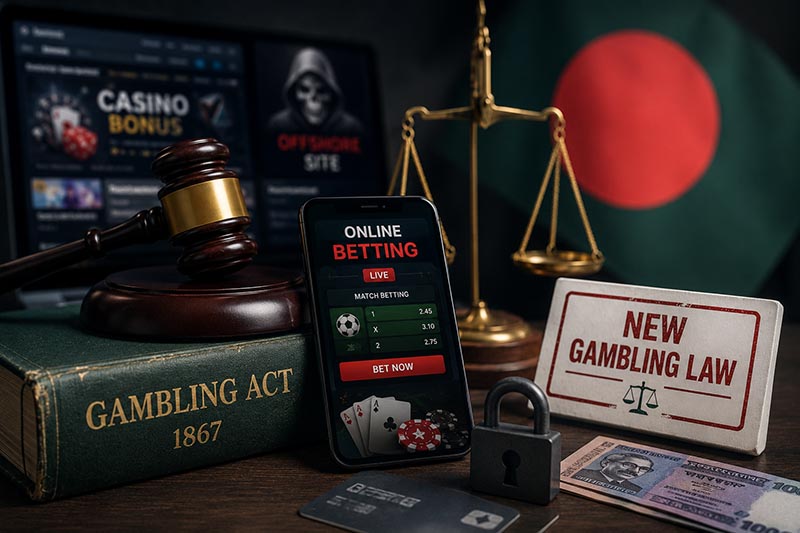
Bangladesh is moving to replace its colonial-era gambling law with a sharper framework aimed at online betting, digital payments, and the offshore platforms old legislation was never built to catch.
A Colonial Law Runs into the App Era
Bangladesh’s government says a new anti-gambling bill is now in its final drafting stage and is expected to be placed before parliament in its next session. Home Minister Salahuddin Ahmed announced the plan during a meeting with the Bangladesh Secretariat Reporters Forum in Dhaka, saying the country needs a modern law to tackle gambling, betting, and online wagering.
The move would replace the Gambling Act of 1867, a law written for common gaming houses, not smartphones, VPNs, e-wallets, cricket betting ads, or casino apps dressed up as harmless entertainment. World Casino Directory reported that the new framework is being shaped around the rise of online gambling and its social impact, with officials seeing the old statute as badly outmatched.
Why Dhaka Is Moving Now
Ahmed framed online gambling as a threat to young people, the economy, and social stability. That is not just political theatre. Earlier this month, he told reporters that curbing illegal drug trading and online gambling was a government priority, adding that authorities were working to shut down online gambling portals.
The timing also follows a year of tougher digital enforcement. In 2025, the government began legal action against more than 1,100 agents accused of involvement in online gambling, while cyber-security provisions made creating, operating, promoting, or advertising online gambling punishable by up to two years in prison, a fine of up to Tk1 crore, or both.
The Money Trail Is Getting Harder to Ignore
The real pressure point may be payments. Asia Gaming Brief reported that Bangladesh Bank directed all 13 mobile financial service providers to take urgent steps against gambling-linked transactions, with one central bank official estimating that funds moved abroad through online gambling could reach about Tk50 billion, or roughly $407 million.
Bangladesh’s Financial Intelligence Unit has already suspended 21,725 mobile financial service accounts allegedly tied to online gambling and hundi, a traditional informal money transfer system. Most of those accounts were linked to major mobile money brands such as bKash, Nagad, and Rocket, according to BSS.
For the average player, that matters more than a headline about parliament. A ban on a website is annoying. A blocked wallet, frozen account, or flagged agent can turn a quick flutter into a financial headache. Regulators appear to know this, which is why the crackdown is moving from websites to the rails that actually carry the cash.
Ads Put the Problem in Players’ Pockets
Bangladesh’s gambling problem is not only hiding on shady domains. Dismislab found that betting ads were reaching users inside popular mobile games, with nearly one in every 11 ads in its monitored sample pushing betting or gambling. The study tracked six widely used games, including Ludo King, 8 Ball Pool, and Cricket League, and recorded 77 betting-related ads over 30 hours of gameplay.
That is a nasty little loophole. Players, including young users, may think they are watching a game reward ad, only to be nudged toward a betting site promising easy money. Dismislab also reported that some ads were disguised as entertainment games before redirecting users to real-money gambling platforms.
Parliament Gets the Next Move
The new law has not yet been published in full, so the details still matter. Key questions remain over whether the bill will focus mainly on operators and payment facilitators, or whether individual players will face broader exposure as well. The government has already made clear that online gambling, promotion, payment support, and related fraud are all on its radar.
For now, the direction is plain enough. Bangladesh wants to retire a 159-year-old law and replace it with one built for the era of mobile wallets, social ads, and offshore betting platforms. The old act was chasing card rooms. The new one looks ready to chase the phone in your hand.