
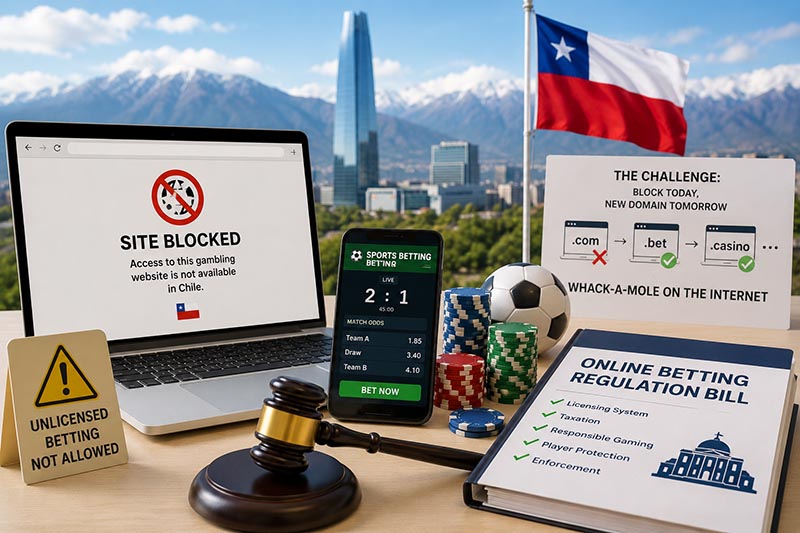
Chile’s attempt to choke off offshore betting sites has hit the old internet whack-a-mole problem, just as President José Antonio Kast’s government faces pressure to stop blocking and start regulating.
Subtel Hits the Limits of the Block Button
Chile’s online gambling fight has entered its awkward phase. The Supreme Court wants unlicensed betting sites blocked, telecoms have been told to get on with it, and Subtel now admits the fix is far from tidy.
According to SBC Noticias, Subtel told lawmakers that operators quickly dodged the first blocking measures by switching domains, leaving the order aimed at web addresses rather than the gambling businesses behind them. For players, that means the “blocked” casino or sportsbook may disappear from one URL and pop up under another faster than regulators can update the paperwork.
Romina Garrido, Chile’s Undersecretary of Telecommunications, also told the Chamber of Deputies’ Constitution Committee that Subtel was not a direct party to the case, limiting its role to technical coordination rather than full enforcement muscle. The agency has floated tools such as deep packet inspection and keyword blocking, but those options carry the usual mix of cost, complexity and civil-liberties headaches.
Courts Want a Harder Line
The legal pressure is not fading. In September 2025, Chile’s Supreme Court accepted a protection appeal from Lotería de Concepción and ordered ISPs to block access to online sports betting sites operating without legal authorisation. The court said only companies authorised by law can offer sports betting in Chile.
That order later spilled into the mirror-site problem. In April 2026, the Supreme Court reversed a Santiago Court of Appeals decision that had treated the original block as fulfilled, even though betting platforms were still reachable through alternative URLs. SiGMA reported that the matter was sent back so judges could push for more effective compliance against mirror domains.
The practical issue is plain enough: blocking a domain is easy; keeping determined offshore brands off Chilean screens is not. That matters to ordinary players because a half-working blackout creates confusion. One site looks unavailable, another clone keeps taking bets, and nobody gets a clear answer on who is accountable if withdrawals stall or terms suddenly change.
Congress Has a Bill Waiting in the Wings
The cleaner route is still regulation, and Chile already has a vehicle for it. Bill 14,838-03, which would regulate online betting platforms, entered Congress on March 7, 2022 and remains in its second constitutional stage, according to the Chamber of Deputies. The bill was given “suma urgencia” again on May 6, 2026.
The framework would create a licensing system for online operators, expand the role of the casino regulator, and bring digital betting under tax, advertising and player-protection rules. Recent industry reporting says the proposal includes a 20% tax on gross revenue, VAT, a 1% responsible gambling contribution and enforcement powers aimed at unlicensed sites and payments.
That is the part players should care about. A regulated market would not make every operator wonderful overnight, because this is gambling and the house is not running a charity. But licensing usually gives customers clearer complaint routes, safer account checks and fewer mystery operators hiding behind offshore small print.
Kast Inherits The Mess
President José Antonio Kast, sworn in on March 11, 2026, has arrived with a wider austerity agenda and a Congress where deal-making will be unavoidable. Reuters reported that his government ordered nearly $4bn in spending cuts shortly after taking office, including a 3% cut across budget items.
That backdrop makes online gambling politically useful and politically awkward. Legalisation can raise tax revenue, but it also forces the government to choose who gets licences, how harshly to treat offshore brands that already served Chilean players, and whether legacy operators such as Polla Chilena and Lotería de Concepción receive special protection.
So Chile is stuck between two imperfect options. One is a court-led blocking campaign that keeps finding new holes. The other is a regulated market that will anger someone no matter how the licence rules are drawn. For players, the second option at least comes with a rulebook. The first mostly comes with error pages, mirror domains and a growing sense that the internet is enjoying the joke.