
A new proposal in Harrisburg would impose gambling-style safeguards on skill-game machines as lawmakers wrestle with one of the state’s most contentious gaming issues.
Lawmaker Pushes for Player Safeguards
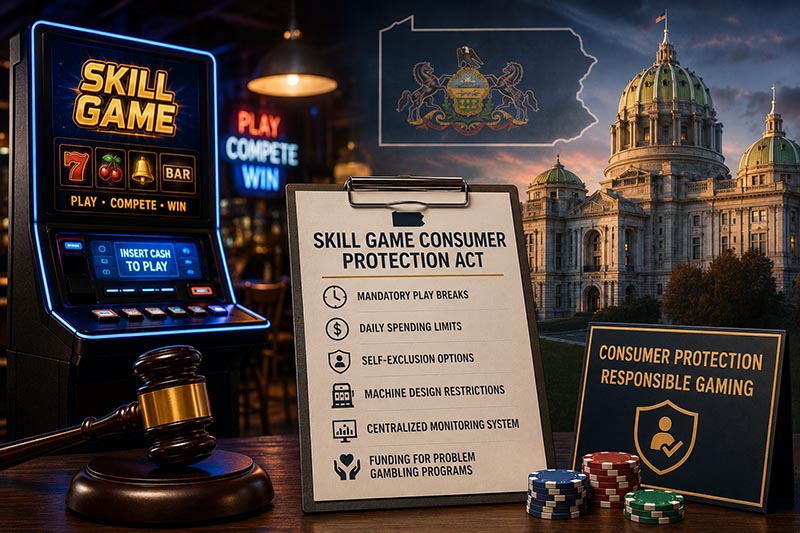
Pennsylvania Representative Ben Waxman has entered the state’s long-running skill-games battle with legislation aimed squarely at consumer protection. His proposal, the Skill Game Consumer Protection Act, would establish a framework of rules for the machines if lawmakers ultimately decide to legalize and regulate them.
The bill arrives as pressure builds on legislators to finally address thousands of skill-game terminals that have spread across bars, restaurants, convenience stores, social clubs, and gas stations throughout the Commonwealth. While the machines remain widely available, they currently operate without the regulatory structure applied to Pennsylvania’s casinos and online gambling platforms.
What The Proposed Rules Would Do
Waxman’s legislation would introduce several measures commonly found in regulated gambling markets.
Among the proposals are mandatory play breaks, daily spending limits, self-exclusion options, restrictions on machine design, and oversight through a centralized monitoring system managed by the Pennsylvania Gaming Control Board. The bill would also direct funding toward problem gambling treatment and prevention programs.
Local governments would gain authority to limit or prohibit skill-game locations within their jurisdictions, while tighter restrictions would be placed on where machines could operate.
For supporters, the proposal addresses a key criticism of the current market: players can access these machines without many of the protections already required in Pennsylvania’s regulated gambling sector.
The Bigger Battle Is Still About Regulation and Taxes
Waxman’s proposal is only one piece of a much larger debate that has frustrated lawmakers for years.
Republican leaders in the Pennsylvania Senate have repeatedly called for legislation that would regulate and tax skill games, arguing the state is missing out on a substantial source of revenue. Governor Josh Shapiro has also supported regulation, previously proposing a 42% tax rate on skill-game revenue while placing the machines under Gaming Control Board oversight.
The problem is that nearly everyone involved wants something different.
Casino operators argue skill games function as unregulated competitors to traditional slots and should face strict oversight and taxation. Skill-game manufacturers and operators counter that the machines provide crucial income for small businesses, veterans’ organizations, taverns, and social clubs throughout the state.
The disagreement has produced competing proposals with tax rates ranging from industry-backed figures in the mid-teens to rates much closer to what Pennsylvania casinos pay.
Courts Could Still Decide the Outcome
Adding another layer of uncertainty, Pennsylvania’s courts continue to play a major role in the issue.
In 2023, the Commonwealth Court ruled that Pace-O-Matic’s skill-game terminals were games of skill rather than traditional slot machines under state law. That decision gave operators a major victory and strengthened arguments that the machines should not be treated exactly like casino slots.
The Pennsylvania Supreme Court has since taken up related cases that could further clarify the machines’ legal status. Any ruling could dramatically influence future legislation and determine how aggressively lawmakers move on regulation and taxation.
Why Online Casino Players Should Pay Attention
For regulated online casino players, the debate may sound distant, but the underlying issue is familiar.
Pennsylvania’s licensed online casinos operate under strict rules covering responsible gambling tools, age verification, self-exclusion programs, and regulatory oversight. Skill games, despite often resembling slot machines, have largely existed outside that framework.
Waxman’s proposal effectively asks whether games that look and feel like gambling should be held to similar standards, regardless of how courts ultimately classify them.
A Decision Harrisburg Can No Longer Avoid
What was once a niche gaming issue has become one of Pennsylvania’s biggest gambling policy questions. Tens of thousands of skill-game terminals are already operating across the state, generating revenue for businesses while drawing criticism from casinos, lawmakers, and responsible-gambling advocates.
Whether the final answer is tighter regulation, higher taxes, stricter consumer protections, or some combination of all three, momentum is building toward action. The only thing lawmakers seem to agree on is that the current gray area is becoming harder to defend with each passing year.