
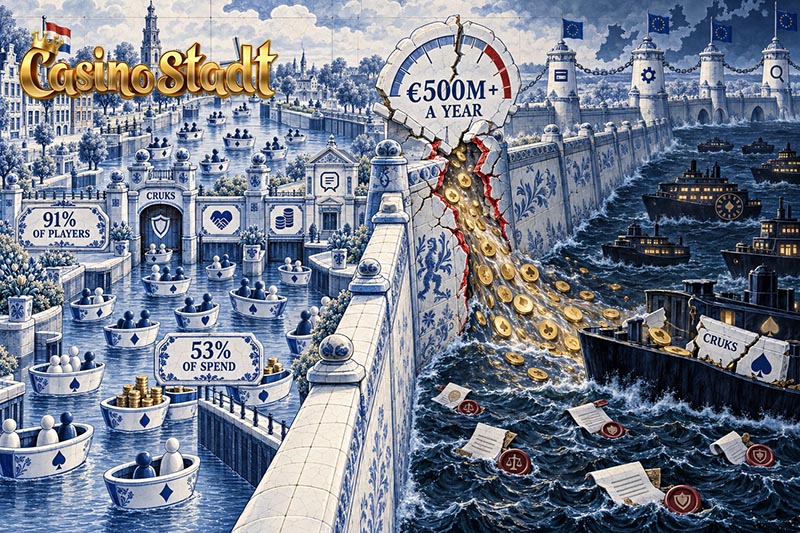
Dutch gambling chief Michel Groothuizen says roughly half of the money lost by local online gamblers is now flowing outside the licensed market, sharpening concerns about what players give up when they move offshore.
Half the Money Is Leaving the Legal Market
The Netherlands has a gambling leakage problem, and the country’s regulator says it is no longer something national enforcement can comfortably contain. Kansspelautoriteit chairman Michel Groothuizen estimates that unlicensed operators are costing the Dutch state more than €500 million in unpaid gambling taxes each year. He also says around half of every euro lost by Dutch gamblers now ends up with the illegal market.
That figure is an estimate from the regulator’s chairman rather than a separate audited tax calculation, but it lines up with another uncomfortable KSA metric.
Its spring 2026 market report estimated that 91% of Dutch online gamblers used only legal providers, yet licensed operators captured just 53% of gambling expenditure.
Put simply: most players stay legal, but the smaller group using offshore casinos appears to be losing much more money.
Offshore Players Lose the Safety Net
Tax revenue may grab the headline, but the bigger issue for an ordinary casino player is what disappears once a deposit leaves the licensed system.
Dutch-licensed operators must follow local rules covering deposits, intervention and player protection. Illegal operators are not bound by those requirements.
Groothuizen says some offshore sites actively market themselves to people registered with Cruks, the national self-exclusion system, effectively selling the absence of Dutch safeguards as a feature.
That is the uncomfortable sales pitch of the black market: fewer limits can feel convenient right up until a player needs a limit, a complaint route or help recovering money.
The KSA also says players tend to suffer higher losses on illegal sites, one reason the money-based channelisation rate is much weaker than the player-based figure.
Fines Are Not Solving the Offshore Problem
The regulator has already imposed large financial penalties on illegal operators, but collecting those fines can be another matter.
Offshore gambling groups can change corporate entities, move infrastructure and operate through jurisdictions where Dutch enforcement has limited reach. That makes a fine on paper rather less impressive if nobody can reliably collect it.
Groothuizen is therefore pushing for more coordinated European action aimed at the infrastructure keeping illegal casinos alive: payment providers, technology companies, search platforms and other intermediaries.
His argument is straightforward. A nationally licensed market is being asked to compete with businesses operating across borders, while the regulator trying to stop them remains largely boxed inside one country.
Tighter Rules Can Have a Price
The Netherlands also has to confront an awkward regulatory trade-off.
Legal online gambling revenue has already weakened following tougher player-protection measures and higher gambling taxes. The KSA reported gross gaming revenue of €602 million for the second half of 2025, virtually flat against the previous six months and around 18% below the 2024 level.
Rules designed to protect players do little good if they drive too many high-spending customers toward sites that ignore them.
That does not mean lighter regulation automatically fixes the problem. It means the success of Dutch gambling policy increasingly depends on whether legal operators remain attractive enough for players to stay put.
For Dutch casino users, the dividing line is increasingly simple: the licensed site may come with more friction, but it also comes with somebody locally accountable when the wheels come off.