
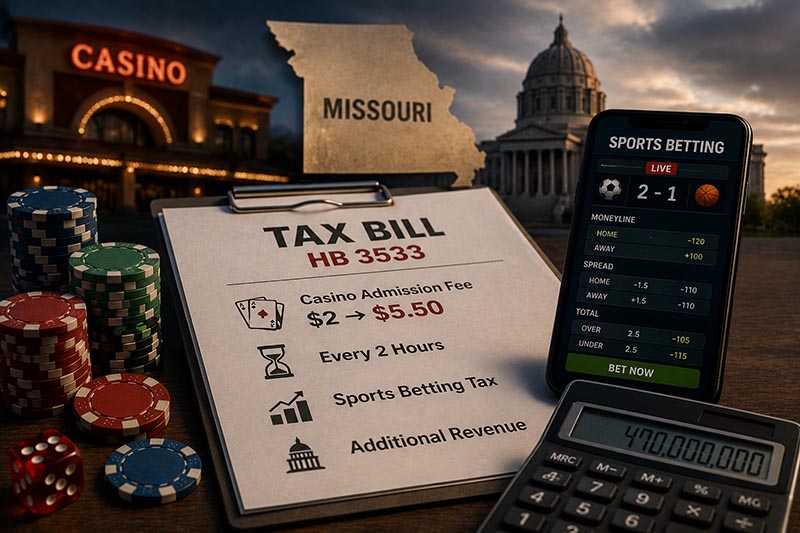
Missouri lawmakers are weighing a casino and sports betting tax overhaul that could raise fresh revenue as the state looks for ways to rely less on income taxes.
Old Casino Fees Get a Fresh Look
Missouri’s casino tax setup may be heading for its biggest shake-up in decades. House Bill 3533, sponsored by Rep. Jeff Knight, R-Lebanon, would raise fees and taxes on the state’s 13 casinos and its licensed sports betting operators. The proposal comes as lawmakers debate how Missouri could replace income tax revenue if the state moves further toward a fee-based funding model.
At the heart of the bill is a casino admission fee that has barely moved since riverboat gambling arrived in Missouri in 1994.
Right now, casinos pay a $2 admission fee on behalf of customers. HB 3533 would raise that charge to $5.50 and apply it every two hours, instead of once per visit. The fee would also be adjusted each year for inflation. Supporters say the current fee no longer reflects today’s costs. Rep. Barry Hovis, R-Whitewater, said the original $2 charge would be worth about $4.31 if adjusted for inflation.
Rep. Tim Taylor, R-Bunceton, also backed a review of the old structure, saying gambling revenue from casinos and the lottery has not kept pace with the state’s needs. For casino players, the fee may not show up as a direct charge at the door. Casinos usually absorb it. Still, higher operating costs have a way of turning up somewhere, whether through tighter promotions, fewer comps, or reduced investment in the gaming floor.
Sportsbooks Could Lose a Promo Advantage
The bill also turns its attention to Missouri’s young sports betting market.HB 3533 would create a 1.5% “remote wagering access fee” for online and remote wagering. The first $35 million from that fee would be directed to the Department of Natural Resources Historic Preservation Revolving Fund.
The measure would also add a 13% tax on gambling receipts and a 24% additional tax on sports wagering receipts. Those charges would sit on top of current obligations.
Missouri launched legal sports betting on December 1, 2025. In the first two months, sportsbooks handled close to $1 billion in wagers, but the state collected less than $700,000 in tax revenue. A major reason: promotional deductions reduced taxable revenue, while the current sports betting tax rate is 10%.
HB 3533 would change that by taxing sports betting revenue before promotional deductions.
That matters for bettors. If operators can no longer deduct promos before taxes, welcome offers, odds boosts, bonus bets, and retention deals could become less generous. Sportsbooks do not tend to eat higher tax bills quietly.
Knight has estimated the proposal could bring in about $470 million. Industry representatives are not buying that number.
Casino Industry Warns of a Heavy Hit
Mike Winter, a lobbyist for the Missouri Gaming Association, opposed the bill and said it could cost casinos more than $500 million.
Winter argued that Missouri operators entered the market expecting stable rules. He warned that the proposal could make other states look more attractive to casino companies.
He also pointed to another pressure point: unregulated slot-style machines in convenience stores and gas stations. Casino operators have long argued those machines compete with licensed venues without facing the same tax and regulatory burden.
There is also a legal wrinkle around sports betting taxes. Voters approved Missouri sports betting through a constitutional amendment, and Winter questioned whether lawmakers can change tax terms through ordinary legislation. Committee chair Rep. Jeff Myers, R-Warrenton, said that issue would be addressed separately.
Income Tax Debate Drives the Bigger Fight
The casino bill is part of a much wider tax conversation in Jefferson City.
Missouri lawmakers have been considering ways to reduce or eliminate the state income tax. A related constitutional amendment has moved through the Legislature and could go before voters later this year.
That would leave a large hole to fill. Income tax makes up a major share of Missouri’s general revenue, so lawmakers are looking at other places to collect money.
Hovis tied the casino fee debate directly to that shift, asking how the state would make up the difference if Missouri moves away from income tax and toward more fees. Business groups are wary. Chance Hepola, director of government affairs for the Missouri Chamber of Commerce and Industry, warned lawmakers against putting heavier tax burdens on select industries to fund specific projects.
The bill has been heard in committee but has not reached a full House vote. With the session clock ticking, its chances are unclear. Still, the message is hard to miss: Missouri’s casinos and sportsbooks may be early targets in the state’s search for replacement revenue. For players, that could eventually mean fewer promos, stingier rewards, and a gambling market that feels a little less generous than advertised.