
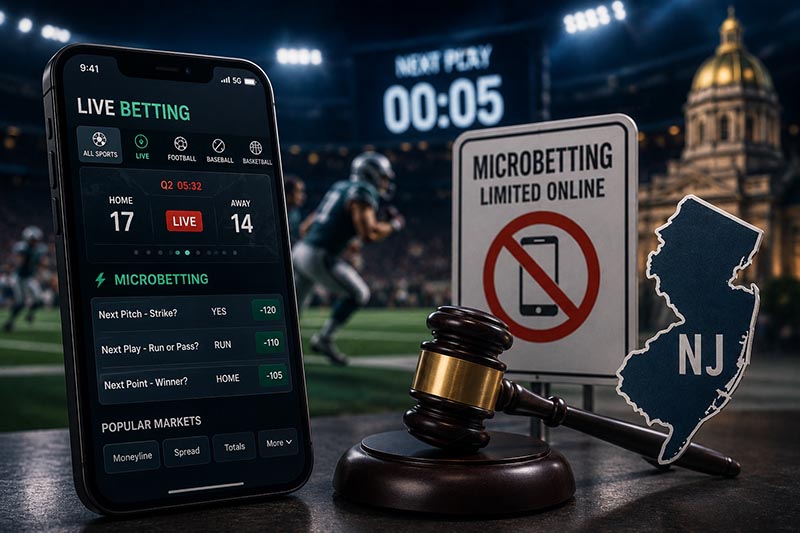
New Jersey lawmakers are moving forward with a bill that would block sportsbooks from offering online microbets, a fast-paced type of live sports wager tied to the very next play or moment in a game. Bill A3258 cleared the Assembly Tourism, Gaming and the Arts Committee this week, but it still needs approval from the full Assembly, Senate, and governor before becoming law.
For players, this is not a ban on sports betting. It is a proposed limit on one specific type of bet: rapid-fire wagers made through mobile or online sportsbook platforms.
What Is Microbetting?
Microbetting means betting on something that happens almost immediately. Think: Will the next baseball pitch be a strike? Will the next football play be a run or a pass? Will the next tennis serve be an ace?
That is different from betting on who wins the game, the point spread, the total score, or even a player’s full-game performance. The New Jersey bill defines a microbet as a live prop bet tied to the outcome of the next play or action during a sporting event.
What Would Change for Players?
If the bill becomes law, New Jersey bettors would no longer be able to place microbets through online sportsbooks or mobile apps. However, the current Assembly version would still allow microbets in person at sports wagering lounges and through authorized self-service betting machines at licensed facilities.
In plain English: your phone app could lose next-play betting markets, but retail sportsbooks could still offer them.
Regular Sports Bets Would Still Be Available
The proposal does not wipe out standard sports betting. Players would still be able to bet on moneylines, spreads, totals, futures, and many other legal markets. The target is much narrower: bets that settle within seconds and can be placed over and over during a live game.
That distinction matters. A player betting on the Eagles to win is making one decision. A player betting on every snap, pitch, or possession may be making dozens or even hundreds of decisions in one game.
Why Lawmakers Are Concerned
Supporters say microbetting moves too quickly and gives players very little time to think before placing the next wager. Assemblyman Dan Hutchison said sports betting has grown quickly and safeguards need to keep up, while Assemblyman Cody Miller warned that betting with “a few taps every few seconds” can turn gambling from entertainment into habit.
That is the heart of the bill: slow down the most repetitive form of betting before it becomes a bigger problem for players.
Why Online Betting Is the Main Focus
The bill focuses on mobile and online sportsbooks because that is where microbetting can become almost frictionless. A player sitting on the couch can tap, lose, reload mentally, and tap again within seconds.
New Jersey already has a mature online betting market. The state legalized sports wagering at casinos and racetracks in 2018, and online sports betting has become a major part of the market since then.
Problem Gambling Is Part of the Debate
The proposal comes as gambling-related harm remains a major concern nationwide. The National Council on Problem Gambling reported that nearly 20 million U.S. adults experienced at least one problematic gambling behavior “many times” in the past year, with higher-risk behavior especially visible among younger adults, online gamblers, and sports bettors.
For players, that does not mean every microbettor has a gambling problem. It means lawmakers see rapid, repeated betting as a higher-risk product than slower, more traditional wagers.
Sportsbooks May Push Back
Sportsbooks like microbetting because it keeps players engaged throughout a game. Instead of waiting for the final score, bettors can keep wagering play by play. That creates more action, more screen time, and more betting volume.
Opponents are likely to argue that restrictions could push some players toward offshore or unregulated betting sites. That is a common industry argument whenever states limit legal sportsbook products. But supporters say player protection comes first, especially when a product is built around speed and constant re-betting.