
Macau’s casino market bounced back in August after the World Cup disrupted high-value play, and analysts now expect September to put year-on-year growth back on the board.
August Brings Macau Back to Life
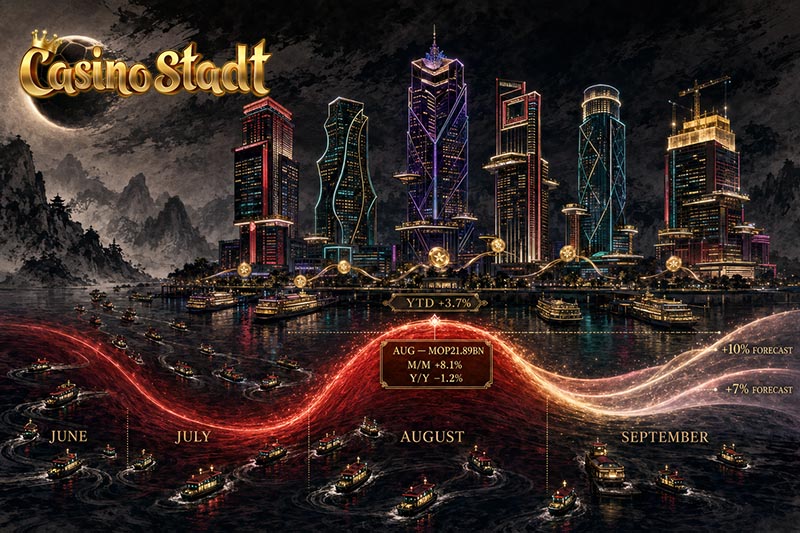
Macau casinos generated MOP21.89bn ($2.71bn) in gross gaming revenue during August, an 8.1% rise from July as the market continued to shake off disruption linked to the 2026 FIFA World Cup.
The result was still 1.2% below August 2025, marking a third consecutive month of year-on-year decline. Yet the monthly improvement was clear after GGR fell 12.1% year on year in June and 8.4% in July.
For the first eight months of 2026, Macau GGR reached MOP169.05bn, putting the market 3.7% ahead of the same period last year.
The World Cup ran from June 11 to July 19 and competed for the attention of Macau’s premium-mass and VIP customers. That matters in a market where a relatively small group of high-spending players can move monthly casino numbers more than operators would like.
Still, the expected rush of pent-up casino demand after the tournament did not fully arrive in August. Melco Resorts executives had already cautioned that customers who skipped Macau during the World Cup were unlikely simply to make up those trips later.
September Forecasts Point Higher
The next test could look considerably better on paper. JP Morgan Securities now expects Macau to produce around MOP19.64bn in September GGR, which would represent growth of roughly 7% from a year earlier. Seaport Research Partners is more bullish, forecasting approximately MOP20.12bn and year-on-year growth of around 10%.
That would end the run of annual declines seen through June, July and August and offer cleaner evidence that the World Cup hangover has passed. The forecasts also show why August should not be treated as a simple comeback story. Revenue recovered sharply from July, but the market still missed earlier expectations. Citigroup had reduced its August forecast to MOP22.5bn late in the month, yet the final MOP21.89bn total still came in below that revised figure.
For casino players, this is less about a dramatic change on the gaming floor and more about operators fighting harder for the same premium customers. That battle is increasingly visible in market-share numbers.
Sands Leads, but Rivals Are Closing In
Sands China remained Macau’s largest operator by GGR share in the second quarter, holding roughly 24% of the market, according to JP Morgan analysis.
Galaxy Entertainment followed at 21%, with MGM at 17%, Melco at 15%, Wynn at 14% and SJM at 10%. Sands’ share slipped by around two percentage points from the previous quarter, while Wynn was the standout mover, gaining 1.2 percentage points to reach its highest share in two years.
Galaxy also continues to lean heavily on mass-market gaming. The operator reported mass GGR of HK$19.1bn for the first half of 2026, up 12% year on year, while total GGR rose 8% to HK$24.8bn. Its VIP GGR dropped 32% year on year during Q2, partly because of a lower win rate and weaker rolling-chip performance.
Sands had its own rough quarter. Macau net revenue slipped 0.8% year on year to $1.78bn in Q2, while adjusted property EBITDA fell to $430m. The company blamed unusually low hold in rolling play, although gaming volumes increased across its Macau operations.
The numbers make Macau’s current pecking order less comfortable than the headline rankings suggest. Sands remains out front, but Galaxy, MGM and an improving Wynn are giving the market leader little room for a quiet quarter.
More Visitors Do Not Automatically Mean More Casino Spend
Macau continues to draw large visitor volumes, which gives operators a healthy pool of potential customers even as gaming habits change.
Visitor arrivals reached 24.49 million during the first seven months of 2026, up 8% from a year earlier. Mainland Chinese arrivals continued to drive the market, while Individual Visit Scheme traffic rose 9.6% year on year in July alone.
There is a catch. Same-day visitors grew 13.9% during the first seven months, while overnight visitor numbers edged 0.3% lower.
That mix matters for integrated resorts. More people crossing the border is useful, but operators would much rather keep visitors in hotel rooms, restaurants, shops and casinos for longer.
Macau’s post-World Cup rebound therefore remains a work in progress rather than a victory lap.
August repaired much of July’s damage, September forecasts are pointing in the right direction, and year-to-date revenue remains ahead of 2025. The bigger fight is now between six concessionaires trying to turn growing visitor traffic into profitable casino spend without relying too heavily on a volatile VIP crowd.