
Bally’s delivered a sharp rise in second-quarter revenue, with its online operations doing much of the heavy lifting while the casino floor produced steadier growth.
Online Growth Pushes Revenue Higher
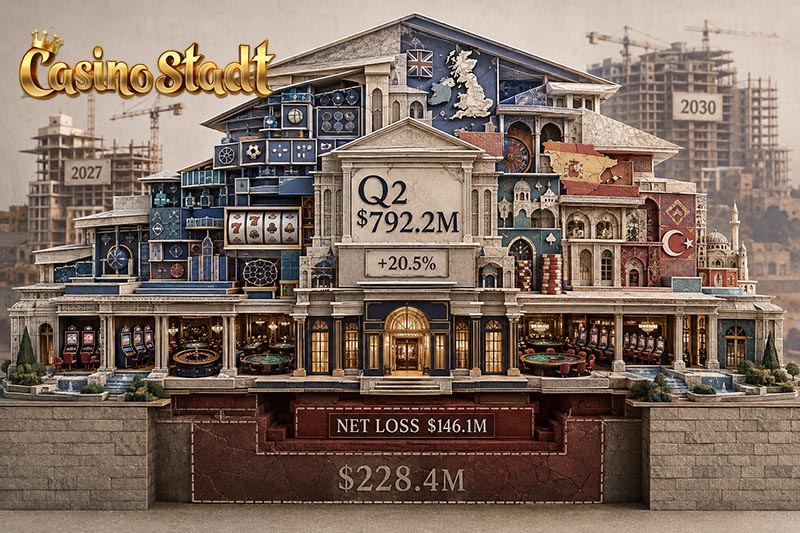
Bally’s Corporation generated $792.2 million in revenue during Q2 2026, up 20.5% from $657.5 million a year earlier. The company’s Casinos & Resorts arm remained its biggest contributor, producing $401.0 million, although that represented a more modest 2% year-on-year increase.
Bally’s credited stronger results at its Baton Rouge and Marquette casinos following their moves to landside locations, along with growth at its temporary Chicago casino. Properties in the Quad Cities also performed well, while tougher competition weighed on Atlantic City and East Saint Louis. Casino and resort adjusted EBITDAR rose 3.4% to $109.6 million.
The group also reported a 4.3% increase in rated casino visitation, giving Bally’s a little more evidence that customers are still walking through the doors even as its digital business takes a larger role.
Bally’s Online Divisions Find Another Gear
North America Interactive revenue climbed 16.9% to $66.1 million, covering Bally’s online casino and sports betting operations in the US and Canada. Segment adjusted EBITDAR reached $3.0 million, up from $2.5 million in the same quarter last year.
That profitability matters almost as much as the revenue increase. US online gambling businesses have spent years proving they can attract players. The harder trick has been doing it without burning through mountains of promotional cash.
Bally’s CEO Robeson Reeves said customer-focused changes and greater automation introduced over the past year are now feeding through to the division’s financial performance. Based on its Q2 pace, the North American digital unit is running at more than $250 million in annualised revenue.
UK Players Keep Bally’s Intralot Moving
Bally’s Intralot B2C was another major contributor, with quarterly revenue rising 22.3% to $243.5 million. UK online revenue increased 11.6% in constant currency, while Spain delivered 15.1% growth. The addition of Intralot’s Turkish sports betting business also lifted the comparison with 2025.
The UK performance came despite the gaming tax rate increasing from 21% to 40% on April 1. Bally’s said it offset some of that pressure through revenue growth and tighter costs, while achieving its UK gains without increasing marketing spend.
For the everyday casino player, that last point is worth watching. Bally’s appears more interested in squeezing better retention and engagement from its existing products than simply throwing bigger bonus offers at the market.
Revenue Is Up, but the Loss Has Not Vanished
The bigger revenue number did not turn Bally’s profitable. The company recorded a net loss of $146.1 million for the quarter, although that was considerably narrower than the $228.4 million loss reported a year earlier. Loss per share improved to $2.41 from $3.76.
For the first six months of 2026, Bally’s generated approximately $1.55 billion in revenue, compared with pro forma revenue of $1.27 billion for the same period of 2025.
Chicago and the Bronx Loom Large
Bally’s still has some very expensive irons in the fire. The company is targeting an early 2027 opening for its permanent Chicago casino, while its planned $4 billion Bronx resort is expected to open by 2030. Bally’s said it is seeking additional debt and equity financing for the New York development.
Its international ambitions are growing as well. Bally’s Intralot announced an agreement in June to acquire evoke plc, the group behind brands including 888 and William Hill.
For players, Bally’s increasingly looks less like a collection of regional casinos with an online side business and more like a gambling group trying to connect retail casinos, sportsbooks, iGaming and international brands under one roof. Q2 suggests the digital side is gaining ground quickly, even if Bally’s balance sheet still gives management plenty to think about.