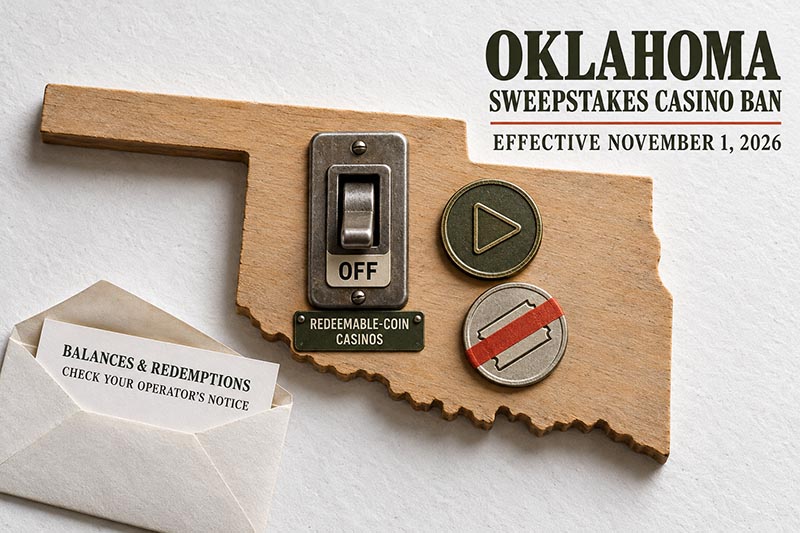
Oklahoma’s sweepstakes casino ban takes effect on November 1, 2026, closing the state to online casino platforms that use redeemable virtual currencies. The law also extends criminal liability to businesses that help operate or promote prohibited games.
Operators have been withdrawing ahead of the deadline. McLuck’s published terms confirm that it will stop operating in Oklahoma from November 1, while other brands have introduced their own restrictions during October.
Players Face Different Rules for Remaining Balances
The immediate concern for existing customers is what happens to unused coins and pending prize requests. Operators have followed different schedules for stopping purchases, ending play and closing redemptions.
Gamingo News reported that Stake.us ended Oklahoma gameplay on October 30 while continuing to allow redemptions. It also reported that Modo was removing Sweeps Coin play while retaining games using nonredeemable Gold Coins.
Those differences make each platform’s closure notice important. The law’s November 1 start date does not establish a shared redemption window, and an account remaining accessible does not necessarily mean every service remains available.
The Law Explicitly Covers Redeemable Virtual Currency
Senate Bill 1589 expands an existing gambling offense to expressly include online casino games. Its definition of value covers currencies within a two-currency system that can produce cash, prizes or opportunities to win something valuable.
Sweepstakes casinos commonly separate entertainment coins from promotional coins that can lead to redeemable prizes. The new wording directly addresses that structure, bringing the redeemable side of the model within Oklahoma’s criminal gambling provisions.
The legislation retains exceptions for qualifying charitable games and gambling authorized on Indian lands in compliance with the Indian Gaming Regulatory Act.
Suppliers and Affiliates Also Face Criminal Exposure
The statute specifically names geolocation providers, gaming suppliers and platform providers, along with promoters and media affiliates, among those potentially liable for supporting prohibited games.
A conviction carries a Class C2 felony, a fine between $500 and $2,000, and imprisonment under the applicable sentencing provisions. For the industry, the law therefore affects the supporting businesses behind a casino website as well as its operator.
Governor Kevin Stitt vetoed the measure in May, objecting to its breadth and its treatment of service providers. Lawmakers overrode him on May 14, with votes of 34 to 10 in the Senate and 68 to 19 in the House, establishing the law now reaching its effective date.