
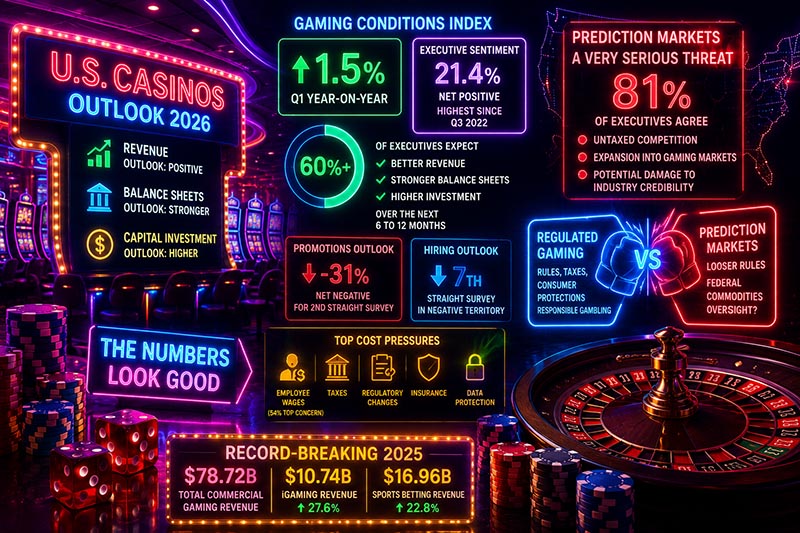
The American Gaming Association’s spring outlook shows U.S. gaming leaders still expect growth in revenue and investment, even as prediction markets, costs and regulatory fights become a much louder part of the room.
A Healthy Market With a Nervous Edge
The U.S. casino sector opened 2026 in solid shape. AGA’s Gaming Conditions Index rose 1.5% year-on-year in Q1, while executive sentiment hit 21.4% net positive, its strongest reading since Q3 2022. The survey drew responses from 26 senior AGA member executives between March 23 and April 8.
More than 60% of executives expect better revenue, stronger balance sheets and higher capital investment over the next six to 12 months. That is a pretty cheerful boardroom mood, especially for a sector still dealing with inflation, tariff worries, supply-chain costs and customers who are not exactly finding cheaper groceries at checkout.
Fewer Freebies, More Margin Watching
For the regular online casino or sportsbook player, the most useful detail may be the promo outlook. Executives expect promotional activity to fall for a second straight survey, with a 31% net negative reading. Translation: operators may still want your action, but they may be less eager to bury you in bonus offers to get it.
Hiring expectations also stayed negative for a seventh straight survey period, while 54% of executives picked employee wages as their top expense pressure. Taxes, regulatory changes, insurance and data protection also showed up as cost headaches, which helps explain why operators are guarding margins more closely.
Prediction Markets Move From Nuisance to Headache
The sharpest warning in the report was aimed at prediction markets. AGA said 81% of executives view those platforms as a very serious threat to regulated gaming, with executives citing untaxed competition, expansion into gaming markets and possible damage to industry credibility.
The concern is easy to follow. Sports event contracts can look and feel a lot like a bet on a game, but some platforms argue they sit under federal commodities oversight rather than state sportsbook rules. AGA research released in September 2025 found that 85% of surveyed voters see sports event contracts as gambling, while 80% said they should be regulated like online sports betting.
The Court Picture Is Anything But Tidy
Kalshi won a key April ruling when the Third Circuit said New Jersey could not restrict its sports-related event contracts, finding that the Commodity Futures Trading Commission held authority over those contracts under federal law. An Arizona federal judge later paused state enforcement against Kalshi, adding another win for the prediction-market side.
Nevada has pushed the other way. A state judge temporarily blocked Kalshi from operating there without gaming licenses, after regulators argued the company was offering unlicensed gambling. So, no, this fight is not settled. It is more like a roulette wheel still spinning while everyone argues about who owns the table.
Why Players Should Care
The legal fight matters because regulated sportsbooks and online casinos come with state licensing, tax obligations, responsible gambling tools and formal complaint routes. Prediction markets may offer wider access and different pricing, but the consumer protections can be less familiar to the average player. That gap is why the casino lobby is pounding the table, and why states are unlikely to shrug this off.
For now, the U.S. gaming market is still growing. Commercial gaming hit a record $78.72 billion in 2025, with iGaming revenue up 27.6% to $10.74 billion and sports betting revenue up 22.8% to $16.96 billion. The money is there. The fight now is over who gets to take the bet, who pays tax on it and who has to follow the stricter rulebook.